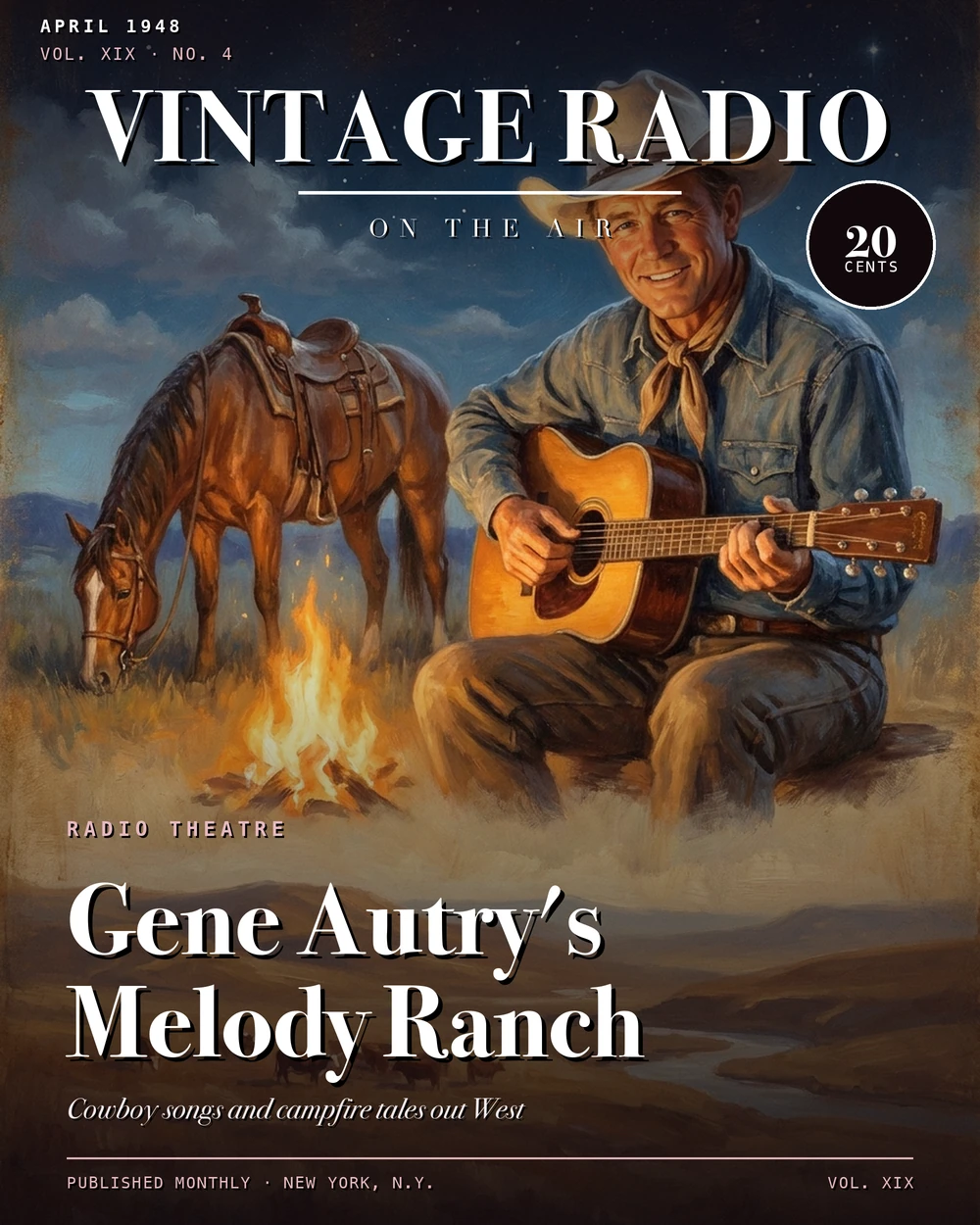
Gene Autry's Melody Ranch
How It Got on the Air
Gene Autry was on the set of his 39th Republic Pictures film, Shooting High, when Danny Danker from the J. Walter Thompson advertising agency called to arrange an audition for the William Wrigley Jr. Company. Autry told Frankie Marvin and Carl Cotner to pack their fiddles, and the three of them went in to play for the Wrigley people at CBS. The audition worked. A 15-minute pilot aired on December 31, 1939, and the regular Sunday run began January 7, 1940 — replacing Gateway to Hollywood, the previous Wrigley-sponsored program. A brief item in the January 1, 1940, issue of Broadcasting magazine noted that the new program "will feature Gene Autry, singing cowboy, and dramatics" and would be carried on 67 CBS stations.
Autry came to the audition with a track record that made the pitch easy. He had started singing on KVOO in Tulsa in 1930, billed as "Oklahoma's Yodeling Cowboy," then moved to WLS in Chicago in 1931 for $35 a week. He was heard on The National Barn Dance and The National Farm and Home Hour, and by the mid-to-late 1930s he was making guest appearances on major variety programs including Rudy Vallee's Fleischmann Hour and The Eddie Cantor Show. His screen career had begun in 1934 at Republic Pictures, and by 1940 he was the number-one western box-office star in the country — Roy Rogers ranked second. That same year, the National Association of Theater Owners voted him the fourth biggest box-office attraction overall, behind Mickey Rooney, Clark Gable, and Spencer Tracy.
Autry claimed that a turning point came years earlier, when Will Rogers walked into a telegraph office where Autry was working, heard him sing, and encouraged him to pursue music seriously. Whether or not the story is exact, it fit the persona he'd built: a working ranch hand turned singing cowboy, authentic enough to carry a radio show with his own name in the title. The show was initially called Doublemint's Melody Ranch; the name was changed to Gene Autry's Melody Ranch in early 1941.
What the Show Sounded Like
The format stayed consistent across the show's long run: a few songs — including at least one designated "Cowboy Classic" — comic banter between Autry and his regular cast, and a dramatized story running roughly ten to fifteen minutes, with Autry as the two-fisted hero. A Movie-Radio Guide article from 1941 described the kinds of plots that turned up: "Sometimes they're initiating an eastern tenderfoot visiting the ranch; sometimes they're saving the school teacher and her children trapped in a ring of fire." The stories were short and punchy, built for a Sunday-evening family audience.
The music was firmly Western, with heavy accordion emphasis. Carl Cotner served as music director, arranger, and orchestra leader — a role he held for decades. Cotner had been with Autry since the mid-1930s, when Autry gave him his start in show business as a fiddle player; the association lasted roughly fifty years and included Cotner serving as Autry's stand-in in several films. Johnny Marvin led the orchestra in the show's early period, but he died on December 20, 1944. In the later years, as Wrigley trimmed the budget, the violin section was replaced by an organ.
Behind the microphones, Bill Burch served as producer through most of the run, with a sound-effects crew that included Jerry McCarty, Gene Twombly, Ray Erlenbom, David Light, and Gus Bayz handling the gunfire, hoofbeats, and saloon-door work that any Western drama lived or died by. The regular announcers were Tom Hanlon, Lou Crosby, and Charlie Lyon, though the booth rotation occasionally widened — Tom Shirley turns up on the October 1, 1949, broadcast, and Bob Williams handled the February 25, 1950, episode.
The theme was "Back in the Saddle Again." The song had been written by Ray Whitley for the 1938 film Border G-Man, performed there by Whitley and his Six Bar Cowboys. Autry later co-wrote a revised version with Whitley; that version appeared in Autry's 1939 Republic film Rovin' Tumbleweeds and became his second gold record. The original studio recording was made on April 18, 1939, for the American Record Corporation. Autry's recording was inducted into the Grammy Hall of Fame in 1997 and was ranked the 98th best song of the twentieth century by RIAA voters in 2001. The song also served as the title of Autry's 1976 autobiography.
Longtime announcer Lou Crosby opened the show with the phrase "Where the pavement ends and the West begins." In the late 1940s, Charlie Lyon was well remembered for his opening line: "Now here's the boss man himself, America's favorite cowboy, Gene Autry!"
The Cowboy Code
The show drew a huge young audience, and Autry took that seriously. Over time he developed what came to be called the Cowboy Code — sometimes the Cowboy Commandments — ten ethical guidelines about honesty, respect, and patriotism, aimed squarely at the kids who wanted to ride and shoot and sing like him. The formal ten-point list didn't appear overnight. As early as August 17, 1947, Autry was reciting early versions of the precepts on the Melody Ranch broadcasts themselves, working the philosophy into the show in pieces. Holly George-Warren, in Public Cowboy No. 1: The Life and Times of Gene Autry, traced the code as "a natural progression of Gene's philosophies going back to his first Melody Ranch programs—and early pictures." A 1948 Life magazine feature picked up on it, and the formal Ten Cowboy Commandments evolved out of related publicity, including a list called "Nine Cardinal Rules Govern Production of All Autry Films" that appeared in the 1949 press book for Riders in the Sky.
The Cast That Defined It
The people surrounding Autry on Melody Ranch weren't hired hands — many of them had been with him since his earliest days in the business. Frankie Marvin had known Autry since 1927 and appeared on the very first broadcast. Carl Cotner was there from the start and stayed for the duration. Johnny Bond — born Cyrus Whitfield Bond in Enville, Oklahoma, in 1915 — joined in December 1939 and remained through 1956, contributing both guitar work and comedy. Bond had formed a trio called the Bell Boys (later the Wakely Trio) with Jimmy Wakely and Scotty Harrell in 1937, broadcasting out of WKY in Oklahoma City and KVOO in Tulsa. Autry heard them on tour in the late 1930s and told them, "If you boys ever get to California, look me up." They arrived in Hollywood in May 1940. The Country Music Hall of Fame, which inducted Bond posthumously in September 1999, credited his distinctive acoustic guitar runs as an Autry trademark on both radio and record. Bond played guitar on Autry's recordings of "Back in the Saddle Again" and "You Are My Sunshine."
Pat Buttram — born Maxwell Emmett Buttram on June 19, 1915, in Addison, Alabama, son of a Methodist minister — came to the show in the late 1940s to replace Smiley Burnette. Buttram had spent thirteen years doing comedy on The National Barn Dance, where he was billed as the "Winston County Flash." He had first been discovered at a WLS National Barn Dance audience appearance at the 1933 Chicago World's Fair, when an announcer interviewed him and his comic responses earned him an immediate job offer. He briefly worked as a sidekick for Roy Rogers before Autry brought him on. His comedy style was what you might call audio slapstick. He addressed Autry as "Mister Artery," and a running gag had Autry asking, "Patrick, how can you be so stupid?" to which Buttram reliably answered, "Well, it ain't easy when you ain't got no brains." Buttram's first Autry film was Strawberry Roan in 1948; he went on to co-star in more than forty films and more than a hundred episodes of The Gene Autry Show on television.
Vocal groups rotated through the show over the years: the King Sisters, the Pinafores, Cotner's Melody Ranch Six, the Gene Autry Blue Jeans, and the Cass County Boys — consisting of Bert Dobson, Fred Martin, and Jerry Scroggins. The Pinafores joined when the show returned in September 1945; the Cass County Boys followed in November 1945. In 1953, the King Sisters, performing under the name the Gene Autry Blue Jeans, replaced the Pinafores. Sara Berner appeared in various dramatic roles, often playing Mexican señoritas. Other regular contributors included Eddie Dean, Jimmy Wakely, Harry Lang, Jack Mather, Horace Murphy, Jerry Hausner, and Alvino Rey, who joined around the time the budget cuts took effect in the later years. Clarence Nash — the voice of Donald Duck — even turned up as a guest on at least one episode, preserved on a February 25, 1950, recording held at the Country Music Hall of Fame and Museum.
The War Years and the Wrigley Commitment
The show's one major interruption came when Autry enlisted. He took his Army Air Corps oath live on the air on July 26, 1942, and the program departed that season. What followed was unusual: rather than simply suspending the show, it was renamed Sergeant Gene Autry, retained its CBS timeslot, and shifted its content. Army Air Forces songs replaced cowboy material, and the drama became military-oriented. The program began originating from various Army Air Forces bases through local CBS stations, often from Luke Field's facilities via CBS affiliate KOY in Phoenix, as well as from air fields in Texas. A disclaimer was read on air stating that the U.S. Army Air Forces did not endorse Wrigley's Gum.
What Wrigley did during that period is worth noting. When wartime sugar rationing made it impossible to manufacture Doublemint Gum, the company held onto the show's time slot anyway — still promoting a product they couldn't produce, just to keep the franchise alive. That kind of sponsor loyalty across an entire wartime pause is not common in radio history.
While in service, Autry earned his service pilot wings in June 1944, was promoted to Flight Officer, and was assigned to the 91st Ferrying Squadron of the Air Transport Command at Love Field. He flew C-109 transport aircraft across the Himalayan "Hump" to support B-29 bombing missions. At the end of the war he transferred to Special Services, took a USO troupe to the South Pacific, and was honorably discharged in 1946 — though the show had already returned to the air on September 23, 1945.
Three weeks before Pearl Harbor, on November 16, 1941, the town of Berwyn, Oklahoma, had been renamed Gene Autry in his honor; the Melody Ranch program was broadcast as part of the renaming ceremony from Autry's nearby Flying A Ranch, with more than 35,000 people in attendance. And on December 7, 1941, the live broadcast from the CBS KNX Playhouse Studio C in Hollywood was delayed fifteen minutes for a news update about the Japanese attack on Pearl Harbor. The cast managed to complete a shortened program afterward.
How It Ended
The show returned from the wartime break and ran another decade on CBS, with Wrigley maintaining its sponsorship throughout. The time slot moved around — Sundays at 7 from 1946 to 1948, Saturdays at 8 from 1948 to 1951, Sundays at 6 from 1953 to 1956. In late 1955 or early 1956, the program was cut to 25 minutes to accommodate a five-minute news segment. Then, on May 6, 1956, a previously aired transcribed episode was substituted for a new one — a violation of Wrigley's contract, which required a fresh episode each week. Wrigley cancelled the show. A tribute program hosted by Pat Buttram and announcer Charlie Lyon followed on May 13, 1956, closing out sixteen years of radio.
The television companion, The Gene Autry Show, had been running on CBS since July 23, 1950 — also sponsored by Wrigley's Doublemint Gum, also with Carl Cotner as musical director — and continued through August 1956. In September 1964, a separate television version of Melody Ranch debuted on Autry's own Los Angeles station, KTLA Channel 5. The weekly 60-minute color program aired Saturday evenings and featured Cotner and Bond as co-hosts alongside Billy Mize, with vocalists Cathie Taylor and Joan De Ville, the Jack Halloran Singers, and Cotner's band rounding out the cast. Autry himself, by then retired from performing, made only rare appearances. Guest stars over the run included Rex Allen, Tex Ritter, Jimmy Wakely, and the Sons of the Pioneers. It continued through 1973, with summer reruns beginning in 1971. In 1987, Autry and Buttram returned together for Melody Ranch Theater on The Nashville Network, hosting 91 episodes that paired Autry's classic Western films with the two of them reminiscing on camera.
The radio show itself has fared well in preservation. The early broadcasts were captured live on acetate disc, and surviving episodes span the full 1940–1956 run. In 1973, American Radio Programs reissued episodes for use by radio stations. Beginning in the late 1990s, in cooperation with the Autry Qualified Trust and The Autry Foundation, Image Entertainment restored Autry's films and released them as the Gene Autry Collection — each DVD packaged with excerpts from or a complete Melody Ranch radio episode alongside the picture. The wraparound segments from Melody Ranch Theater were found and restored by Gene Autry Entertainment in 2001 after a yearlong search and were subsequently added to the DVD releases. The series was certified accurate on September 14, 2011, in a two-CD set that gathers a verified portion of the known surviving episodes.
Autry wrote or co-wrote more than 250 songs and recorded more than 600 total. He is a member of both the Country Music Hall of Fame and the Nashville Songwriters Hall of Fame, and the only entertainer to have been awarded stars in all five categories on the Hollywood Walk of Fame — film, television, music, radio, and live performance. Pat Buttram, after his years with Autry, played Mr. Eustace Haney on the CBS television comedy Green Acres from 1965 to 1971, did voice work for several Disney animated features, and in 1982 founded the Golden Boot Awards to honor professionals who made significant contributions to the Western film genre. He died on January 8, 1994, at age 78. Gene Autry died on October 2, 1998, of lymphoma, at his Studio City home. He was 90.